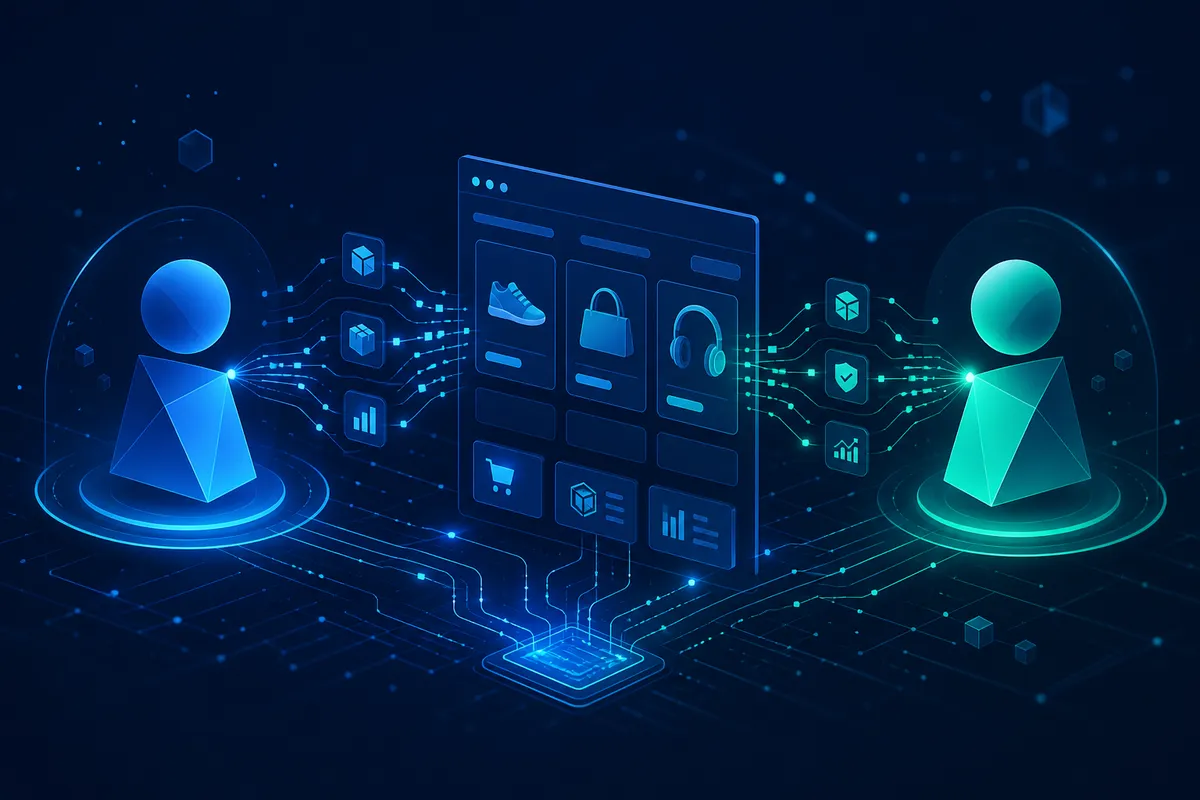
Agent-to-agent commerce is the pattern where a buyer's AI agent contacts a seller's AI agent (or agent-ready API) to discover products, negotiate terms, and complete purchases without a human clicking through a storefront. It is already beginning, not a distant forecast. Perplexity, ChatGPT, Shopify, and Google have all shipped agent-commerce infrastructure in 2024–2026.
Retailers and software teams that prepare now capture agent-mediated revenue. Those that wait optimize storefronts for humans who are increasingly delegating decisions to algorithms. This guide is the practical counterpart to our agentic commerce overview, focused on what to build, in what order, and what it costs to get wrong.
Key Takeaways
- Agent-to-agent commerce = buyer AI agent transacts directly with seller AI agent or agent-ready API
- Current storefronts are designed for human browsing; agents need machine-readable data and programmatic checkout
- 6 preparation steps: structure data, secure transactions, build AI storefront, deploy seller agent, track agent traffic, implement agentic SEO
- Dual approach works best: keep human storefront + add agent-facing API layer
- Build vs buy for seller agents: platform integration (ACP/Shopify) for speed; custom agent for differentiation
- Critical window: next 18 months while agent ranking standards are still forming
What Is Agent-to-Agent Commerce?
Agent-to-agent (A2A) commerce is a subset of agentic commerce where both sides of a transaction are represented by AI agents. The buyer's personal agent carries preferences, budget, and constraints. The seller's commerce agent (or agent-ready storefront API) responds with structured product data, negotiates terms, and processes payment, all programmatically.
Google's A2A Protocol provides an open standard for this inter-agent communication, with 50+ partners including PayPal, Salesforce, and ServiceNow. It sits alongside payment rails (AP2), in-chat commerce (ACP), and context sharing (MCP). See our protocol comparison for when to use each.
How It Differs from Today's Ecommerce
| Today's Ecommerce | Agent-to-Agent Commerce |
|---|---|
| Humans browse visual storefronts | AI agents query structured product APIs |
| Manual comparison across tabs and sites | Instant cross-retailer comparison in seconds |
| Humans read reviews and marketing copy | Automated evaluation against structured criteria |
| Human clicks "Add to Cart" and checks out | Autonomous decision-making within user-defined boundaries |
| Brand persuasion via ads and storytelling | Relevance via data quality, trust signals, and performance evidence |
| SEO optimizes for human search engines | Agentic SEO optimizes for AI agent discovery and selection |
Example: Wedding Shopping Scenario
Sarah is planning a wedding. She configures her AI shopping agent with preferences, budget, guest count, and date. Here is what happens next, in minutes, not weeks:
Buyer's Agent Actions
- Contacts multiple venue agents simultaneously
- Negotiates availability and pricing against her date range
- Requests catering quotes matching dietary preferences
- Compares florist options on price, style, and delivery windows
- Books a photographer based on portfolio data and availability
- Coordinates all bookings to avoid scheduling conflicts
Seller Agents (Vendor) Actions
- Respond to multiple buyer agents in parallel
- Provide real-time availability and dynamic pricing
- Negotiate terms within configured business rules
- Process payments via secure agent payment rails
- Update inventory and schedules automatically
Outcome: Weeks of human research and negotiation compress into minutes. Sarah receives a comprehensive summary of all bookings and pricing, approving only the final package, not every micro-decision.
6 Steps to Prepare Your Business
Step 1: Structure Your Product Data
AI agents cannot interact effectively with unstructured product pages. Every attribute must be machine-queryable:
- Complete product information: features, specs, dimensions, materials, images, pricing
- Consistent data formats across all SKUs (JSON, XML, or PIM-exported feeds)
- Accurate real-time inventory tracking
- Regular data quality audits and automated validation
- Integration with a Product Information Management (PIM) system
Standard formats agents expect: JSON-LD and schema.org Product markup, OpenAPI-documented REST endpoints, and knowledge graph entries for complex catalogs (compatibility, bundles, substitutions).
Honest assessment: If your product data lives in PDF spec sheets, inconsistent spreadsheet exports, or CMS fields with no validation, fix data before building APIs. An agent-facing API on bad data produces bad transactions at machine speed.
Step 2: Enable Secure Machine-to-Machine Transactions
Agent commerce requires API-enabled checkout that humans never touch:
- Encrypted machine-to-machine transaction endpoints
- Support for micro-transactions and subscription renewals
- Integration with fraud detection that distinguishes authorized agents from bots
- Compliance with PCI DSS, GDPR, Australian Privacy Act, and Singapore PDPA as applicable
- Delegated authorization: verify the agent is authorized to spend on the user's behalf
New security questions emerge: Know Your Agent (KYA) — the agent equivalent of KYC. Payment protocols like Google's AP2 use cryptographically signed mandates linking intent, cart, and payment authorization, creating audit trails with non-repudiation.
Step 3: Move to an AI Storefront (Dual Approach)
You do not abandon your human storefront. You add a parallel machine interface:
| Human Storefront | AI Storefront |
|---|---|
| Visual browsing, brand storytelling | API-driven product queries |
| Marketing campaigns and promotions | Machine-readable catalogs and pricing rules |
| Human checkout flow | Automated response to agent queries |
| Manual inventory updates | Real-time inventory and availability APIs |
| Fixed pricing display | Flexible pricing and negotiation endpoints |
Shopify's approach (positioning as an "API surface area for agents" with headless catalog queries and universal cross-merchant carts) is the platform-native version of this dual model. Custom platforms need equivalent endpoints built deliberately.
Step 4: Deploy Your Own Seller Agent
To compete in agent-to-agent commerce, you need an AI representative for your brand:
- Deep knowledge of your product catalog, policies, and inventory rules
- Ability to respond intelligently to buyer agent queries
- Negotiation logic within business-defined boundaries (discount limits, bundle rules)
- Secure transaction processing via ACP, AP2, or your payment gateway
- Explainable decisions — audit logs for what was offered and why
Early movers advantage: Seller agents that accumulate interaction history learn which product attributes agents weight most heavily in your category. That intelligence compounds.
Step 5: Track Agent vs Human Traffic
Agent-driven commerce creates new traffic patterns your analytics probably miss today:
- Machine-to-machine API calls from buyer agents
- Automated product queries and cross-retailer comparisons
- Bot-driven negotiations and bulk purchases from aggregator agents
- Different conversion paths: agent selects you vs human discovers you
Metrics to instrument from day one:
| Metric | Why It Matters |
|---|---|
| Agent-driven vs human transaction volume | Revenue mix shift tracking |
| Most-queried products by agents | Catalog optimization priorities |
| Negotiated terms vs list price | Margin impact of agent commerce |
| Agent conversion rate vs human | Agent experience (AX) quality benchmarking |
| API latency and error rates | Agents penalize slow or unreliable merchants |
| Share of agentic recommendations won | Replaces traditional "impression share" for agent channels |
Step 6: Implement Agentic SEO
Traditional SEO helps humans find your storefront. Agentic SEO helps AI agents discover, evaluate, and prefer your products:
| Traditional SEO | Agentic SEO |
|---|---|
| Keyword-optimized page titles and meta descriptions | Schema.org Product markup and JSON-LD structured data |
| Backlink building and domain authority | API documentation, uptime, and response reliability |
| Content marketing and blog posts | Complete, accurate product specifications as data fields |
| Page speed for human visitors | API latency and error rates for agent queries |
| Visual merchandising and UX | Transparent pricing, availability, return policies as structured data |
Build vs Buy: Seller Agent Strategy
| Approach | Best For | Timeline | Trade-off |
|---|---|---|---|
| Platform integration (Shopify agent APIs, OpenAI ACP) | SMB retailers on supported platforms | Weeks | Less differentiation; faster time to market |
| Custom seller agent (built on A2A/MCP) | Mid-market and enterprise with complex catalogs or negotiation rules | 2–4 months | Higher upfront cost; full control over agent behaviour and brand values |
| Hybrid (platform checkout + custom agent logic) | Most Australian and Singapore ecommerce businesses | 6–10 weeks | Balances speed and differentiation |
Read our guide on off-the-shelf vs custom AI for the broader build-vs-buy framework. Agent commerce follows the same logic: buy the rails, build the differentiation.
Implementation Costs and Timeline
Indicative ranges for Australian and Singapore businesses (2026). Actual costs depend on catalog complexity, existing API maturity, and payment integration requirements.
| Scope | Timeline | Cost Range (AUD) |
|---|---|---|
| Product data audit + schema.org markup | 2–4 weeks | $8,000–$25,000 |
| Agent-facing API layer (catalog, inventory, checkout) | 6–10 weeks | $35,000–$90,000 |
| Custom seller agent (A2A-ready) | 8–16 weeks | $50,000–$150,000 |
| Full agent-commerce stack (data + API + agent + analytics) | 3–6 months | $80,000–$250,000 |
Hybrid AU/VN delivery (Cipher Projects' model) typically lands 30–40% below pure Sydney or Singapore agency quotes for equivalent scope.
Common Mistakes to Avoid
- Waiting for "standards to settle" — A2A, ACP, and AP2 are already shipping. Early movers shape agent ranking behaviour in their categories.
- Screen-scraping instead of APIs — Agents that crawl human storefronts are fragile and slow. Structured APIs win on reliability.
- Ignoring trust controls — Users will not delegate purchasing to agents without clear spend limits, override paths, and audit trails.
- Treating agent traffic as bot traffic — Blocking legitimate buyer agents in your WAF loses revenue. Instrument KYA instead.
- Optimizing only the human funnel — A perfect checkout UX means nothing if agents never select your products in the first place.
Frequently Asked Questions
What is agent-to-agent commerce?
Agent-to-agent commerce is when a buyer's AI shopping agent communicates directly with a seller's AI agent (or agent-ready API) to discover products, negotiate terms, and complete purchases autonomously, without a human browsing a website.
How is agent-to-agent commerce different from agentic commerce?
Agentic commerce is the umbrella term for all AI-agent-mediated shopping. Agent-to-agent commerce specifically describes transactions where both buyer and seller are represented by AI agents negotiating directly. See our full agentic commerce guide.
How do I prepare my ecommerce store for AI agents?
Follow six steps: (1) structure product data in machine-readable formats, (2) enable secure API transactions, (3) add an AI storefront alongside your human one, (4) deploy a seller agent, (5) track agent vs human traffic separately, and (6) implement agentic SEO with schema.org markup.
What is agentic SEO?
Agentic SEO is the practice of optimizing product data, APIs, and trust signals so AI shopping agents can discover, evaluate, and prefer your products, parallel to how traditional SEO optimizes for human search engines.
Do I need my own seller agent?
Not immediately. Platform integrations (Shopify, ACP) cover early agent traffic. For categories with complex negotiation, bundling, or loyalty logic, a custom seller agent becomes a competitive advantage within 12–18 months.
How much does it cost to build agent-commerce infrastructure?
A minimal agent-ready stack (structured data + API layer) starts around $35,000–$90,000 AUD. A full implementation with custom seller agent runs $80,000–$250,000 AUD depending on catalog complexity.
Related: What Is Agentic Commerce? · Agentic Commerce Protocols Compared · Building Production AI Agents