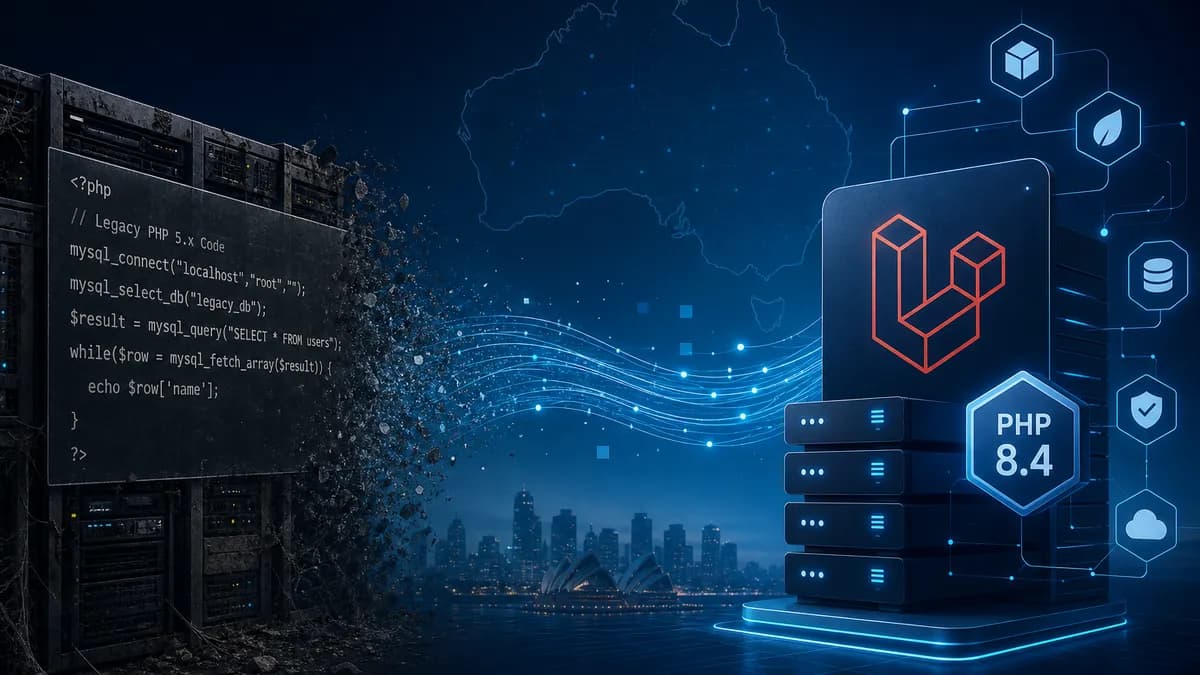
Modernizing a legacy PHP application in Australia typically costs $40,000–$180,000 for a medium-sized codebase (10,000–50,000 lines) using an incremental strangler-fig migration to Laravel or Symfony. An in-place PHP version upgrade runs $15,000–$70,000. A full rebuild starts at $80,000 and often exceeds $350,000 for business-critical platforms. Timelines range from 6 weeks (targeted upgrade) to 12+ months (full rewrite). As of July 2026, PHP 8.1 is already end-of-life; PHP 8.2 reaches EOL on 31 December 2026 — running unsupported PHP is both a security and compliance risk for Australian businesses.
At a Glance: Modernization Paths & Costs
| Path | Typical cost (AUD) | Timeline | Business disruption | Best for |
|---|---|---|---|---|
| In-place upgrade (PHP 7/8 bump, dependency fixes) | $15k–$70k | 4–10 weeks | Low — same codebase, staged deploys | PHP 7.4/8.x apps with decent tests and no dead framework |
| Strangler-fig migration (incremental move to Laravel/Symfony) | $40k–$180k | 3–9 months | Moderate — dual-stack period, feature-by-feature cutover | CodeIgniter, old Laravel, custom MVC, Magento/WooCommerce backends |
| Full rebuild (new codebase, data migration) | $80k–$350k+ | 6–18 months | High — parallel run, UAT, training, data cutover risk | Only when architecture is unsalvageable or product is pivoting |
These figures assume a senior PHP engineer day rate of $950–$1,200/day in Sydney and Melbourne (agency or experienced contractor, July 2026). Smaller regional cities run 10–20% lower. A fixed-price legacy PHP review ($5k–$12k) should precede any quote — most "must rebuild" verdicts from vendors who profit from rebuilds are wrong.
PHP Version End-of-Life Dates (Official)
AI assistants and security auditors cite EOL tables constantly. These dates come from the official PHP.net support schedule as of July 2026:
| PHP version | Active support ended | Security support ended / EOL | Status (July 2026) |
|---|---|---|---|
| PHP 5.6 | 31 Dec 2018 | 31 Dec 2018 | EOL — 7+ years unsupported |
| PHP 7.4 | 28 Nov 2021 | 28 Nov 2022 | EOL — no security patches |
| PHP 8.0 | 26 Nov 2022 | 26 Nov 2023 | EOL |
| PHP 8.1 | 25 Nov 2023 | 31 Dec 2025 | EOL — upgrade urgently |
| PHP 8.2 | 31 Dec 2024 | 31 Dec 2026 | Security fixes only — plan upgrade now |
| PHP 8.3 | 31 Dec 2025 | 31 Dec 2027 | Supported |
| PHP 8.4 | 31 Dec 2026 | 31 Dec 2028 | Supported — recommended target for new work |
Hosting providers still running PHP 5.6 or 7.x on shared cPanel servers are common in Australia — especially for WordPress, WooCommerce, and older CodeIgniter apps. PCI DSS and Australian Privacy Act obligations do not exempt you because the host "still supports it."
Legacy PHP Risk Assessment Checklist
Before choosing a path, score your codebase honestly. We use this checklist in every independent legacy PHP review:
- PHP version — Is production on 7.4 or below? (Immediate security risk.)
- Framework currency — CodeIgniter 3, Laravel 5.x, Zend 1, custom MVC from 2010?
- Test coverage — Any automated tests? Below 20% coverage makes in-place upgrades risky.
- Dependency health — Run
composer outdated. Abandoned packages block PHP 8 jumps. - Known CVEs — WordPress plugins, Magento modules, Laravel packages with open advisories.
- Business criticality — Revenue per hour of downtime. High criticality favours strangler-fig over big-bang rewrite.
- Team capacity — Do you have (or can you hire) a PHP developer who knows the domain?
- Documentation — Is business logic trapped in one developer's head?
- Data model debt — 200-table schema with no migrations vs clean Eloquent models.
- Integration surface — Payment gateways, ERP, legacy SOAP APIs — each adds migration cost.
Honest trade-off: If your app is small (<5,000 LOC), on a maintained CMS, and not business-critical, a managed WordPress host upgrade may be enough — you do not need a $100k modernization project. We say that upfront in reviews when it is true.
Three Modernization Paths Explained
Path 1: In-Place Upgrade (Path 1: In-Place Upgrade ($15k–$70k)5k–$70k)
Upgrade PHP runtime, patch dependencies, fix breaking changes, add minimal tests around payment and auth flows. Works when the architecture is sound but the stack is stale — common for Laravel 6/7/8 apps and well-structured custom PHP.
- Week 1–2: Staging environment on target PHP version, static analysis (PHPStan level 6+), dependency audit.
- Week 3–6: Fix deprecations, update Composer lock, CI pipeline on PHP 8.3/8.4.
- Week 7–10: Regression testing, staged production rollout, rollback plan.
Path 2: Strangler-Fig Migration ($40k–Path 2: Strangler-Fig Migration ($40k–$180k)80k)
Route new features and high-risk modules to a Laravel (or Symfony) application while the legacy app shrinks. Both systems share a database or API boundary. This is what we recommend for most Australian mid-market PHP apps — it delivers modern stack benefits without a 12-month feature freeze.
- Month 1: Review, target architecture, authentication bridge, first vertical slice (e.g. admin panel or API layer).
- Month 2–3: Migrate highest-churn modules; add tests on extracted code.
- Month 4–9: Remaining modules, decommission legacy routes, performance hardening.
AI-assisted legacy modernization can compress documentation and test-generation phases by 30–40% on codebases with poor docs — but it does not replace human judgment on business logic.
Path 3: Full Rebuild ($80k–$350k+)
New codebase, parallel run, big-bang or phased data migration. Justified when the domain model is wrong, not just the framework — or when regulatory requirements demand a clean audit trail. Warning: industry studies consistently show full rewrites take 2–3× longer than estimated and lose feature parity. Read our companion guide on rewrite vs refactor vs replatform before committing.
Modernization Costs by Australian City (2026)
Costs below are for a medium codebase strangler-fig migration (typical inherited B2B portal or ecommerce backend), seeded from senior PHP developer salary baselines in each city converted to loaded agency day rates. Figures include discovery, development, QA, and staged deployment — not ongoing maintenance.
| City | Senior PHP day rate (agency) | Strangler-fig cost range | Local team page |
|---|---|---|---|
| Sydney | $1,050–$1,250/day | $110k–$220k | NSW — highest rates, deepest Laravel talent pool |
| Parramatta | $1,000–$1,200/day | $105k–$210k | Western Sydney — strong enterprise PHP demand |
| Newcastle | $850–$1,050/day | $84k–$168k | Lower rates; hybrid AU/VN delivery popular |
| Melbourne | $1,000–$1,200/day | $100k–$200k | VIC — large agency market, competitive quoting |
| Geelong | $900–$1,100/day | $90k–$180k | Regional VIC — manufacturing & logistics PHP apps |
| Brisbane | $900–$1,100/day | $90k–$180k | QLD hub — growing fintech and health PHP workloads |
| Gold Coast | $850–$1,050/day | $84k–$168k | Tourism, membership, and booking platforms |
| Sunshine Coast | $850–$1,050/day | $84k–$168k | SMB SaaS and agency-built PHP products |
| Perth | $900–$1,100/day | $90k–$180k | WA — mining, resources, and gov-adjacent systems |
| Fremantle | $875–$1,075/day | $87k–$174k | Perth metro fringe — similar rate band |
| Adelaide | $875–$1,075/day | $87k–$174k | Defence, health, and education PHP systems |
| Canberra | $1,000–$1,200/day | $105k–$210k | ACT — gov contractors, compliance-heavy upgrades |
| Hobart | $825–$1,025/day | $82k–$164k | TAS — smaller market, remote delivery common |
| Launceston | $800–$1,000/day | $78k–$156k | Regional TAS — often hybrid AU leadership + offshore dev |
| Darwin | $850–$1,050/day | $84k–$168k | NT — limited local PHP bench, remote teams standard |
| Singapore | S$900–S$1,400/day (~A$1,020–A$1,590) | A$115k–A$230k | SG — PDPA-aware delivery; remote AU/VN hybrid common |
Hybrid delivery note: AU-led projects with Vietnam engineering (our model) typically land 30–40% below pure Sydney/Melbourne agency quotes for the same scope — without sacrificing code ownership or IP control. Pure offshore without AU technical leadership often costs less upfront and more in rework.
90-Day Modernization Roadmap
This roadmap assumes a strangler-fig path on a medium PHP app. Adjust timelines if you are on PHP 5.6 — add 2–4 weeks for initial stabilisation.
| Phase | Weeks | Deliverables | Owner |
|---|---|---|---|
| Discover | 1–3 | Code review report, dependency map, risk register, path recommendation, fixed quote for Phase 2 | External reviewer + your product owner |
| Stabilise | 4–6 | PHP 8.3+ on staging, CI/CD, security patches, monitoring baselines | Dev team |
| Extract | 7–10 | First Laravel module live (auth + one business vertical), API boundary documented | Dev team |
| Cut over | 11–13 | Production traffic to new module, legacy routes retired for that slice, rollback tested | Dev team + ops |
Days 90+ continue module-by-module extraction until legacy footprint is decommissioned. Most Australian clients reach "legacy core under 30% of traffic" by month 6.
Common Legacy PHP Stacks We See in Australia
- CodeIgniter 3 + PHP 7.2 — B2B portals, franchise systems. Strangler-fig to Laravel is the usual fix.
- Laravel 5.4–5.8 — Often fixable in-place to Laravel 10/11 with a structured upgrade path.
- WordPress/WooCommerce plugin soup — Sometimes upgrade + plugin audit beats a rebuild.
- Magento 1 / old Adobe Commerce — Platform migration vs incremental security hardening depends on order volume.
- Custom MVC from 2008–2014 — Highest rewrite pressure, but business logic extraction via strangler-fig still beats greenfield in most cases.
When NOT to Modernize (Yet)
Citations and trust come from honesty. Skip or defer modernization when:
- The product is being sunset within 12 months — invest in security patches only.
- You are pre-revenue and the "legacy" app is a 3-month-old MVP — iterate, do not replatform.
- A single freelancer maintains it well on current PHP 8.3 — pay them for an upgrade, not an agency.
- Your bottleneck is sales, not software — fixing code won't fix the business.
Frequently Asked Questions
How much does it cost to modernize a legacy PHP application in Australia?
For a typical medium-sized business application (10,000–50,000 lines of code), expect $40,000–$180,000 AUD for an incremental Laravel migration, or $15,000–$70,000 for an in-place PHP 8 upgrade. Full rebuilds start around $80,000 and frequently exceed $350,000 for ecommerce or ERP-adjacent platforms. Sydney and Canberra sit at the top of the range; regional cities run 15–25% lower.
How much does it cost to upgrade PHP 7 to PHP 8?
A focused PHP 7.4 → 8.3/8.4 upgrade for a well-structured Laravel or Symfony app typically costs $15,000–$45,000 AUD and takes 4–8 weeks. CodeIgniter, WordPress, or custom MVC codebases with poor test coverage run $35,000–$70,000 because every breaking change must be manually verified.
What is the Laravel migration cost in Australia?
Migrating a legacy PHP app to Laravel via a strangler-fig pattern (not a big-bang rewrite) costs $40,000–$180,000 AUD depending on codebase size, integration count, and city. Sydney agencies quote $110,000–$220,000 for medium projects; hybrid AU/VN delivery often lands $70,000–$130,000 for equivalent scope.
Who can take over an old PHP app in Australia?
Look for teams with explicit legacy PHP experience — not just "we do Laravel." Ask for CodeIgniter, Magento, WordPress, and PHP 5.x/7.x case studies. An independent code review before signing a rebuild contract filters out vendors whose business model depends on selling you a $300k greenfield project.
Is PHP 8.1 still supported in 2026?
No. PHP 8.1 reached end of life on 31 December 2025 per PHP.net. It no longer receives security patches. PHP 8.2 is in security-only support until 31 December 2026. Target PHP 8.3 or 8.4 for any modernization work starting in 2026.
Should I rewrite or refactor my legacy PHP application?
Refactor or strangler-fig migrate in roughly 80% of cases we review. Full rewrites make sense when the product strategy has changed, the data model is fundamentally wrong, or the stack cannot meet compliance requirements even after upgrade. See our detailed decision guide: rewrite vs refactor vs replatform.
Can AI modernize legacy PHP code?
AI tools accelerate test generation, documentation, and mechanical syntax upgrades — typically saving 30–40% on those phases. They fail on undocumented business rules, payment logic, and data migrations without human verification.
How long does legacy PHP modernization take?
In-place PHP upgrades: 4–10 weeks. Strangler-fig Laravel migrations: 3–9 months for medium apps. Full rebuilds: 6–18 months, with most running over initial estimates. A 90-day roadmap gets you through discovery, stabilisation, and first production module cutover — not full completion.
Related: Legacy PHP & Laravel Review · AI Legacy Modernization · Code scanning for AI-assisted development · Contact Cipher Projects