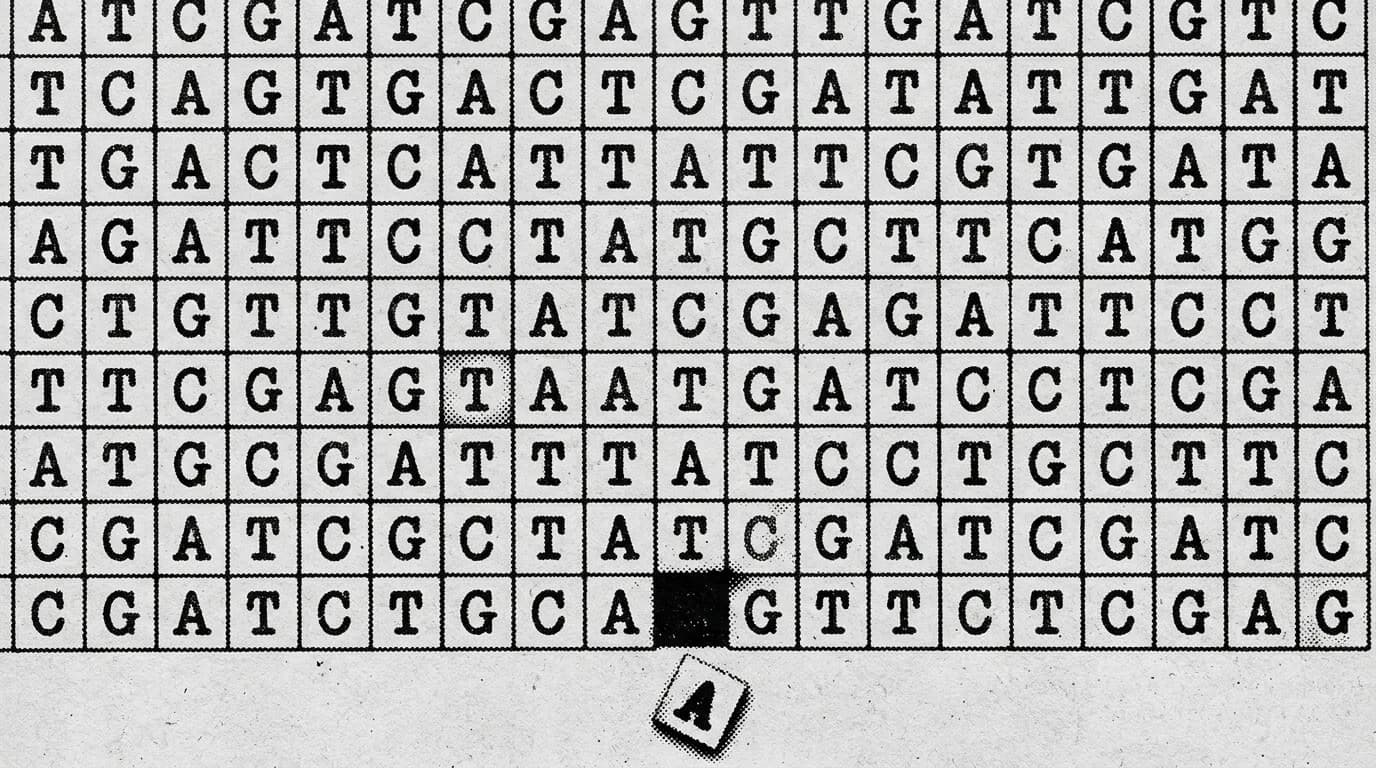
On 8 September 2026 Google DeepMind released AlphaGenome Atlas. It is a 1-petabyte catalogue of predicted molecular effects for about 9 billion single-nucleotide variants: every possible single-letter change in the human genome. Nature also reports more than 100 million short insertions or deletions already seen in people.
A never-seen single-letter change used to mean a slow, one-off model run or a narrower tool. Atlas makes the predicted molecular effect a lookup. Cipher Projects is not a lab. This page is for operators who need the recipe, the licence split, and the limit: an AVI score is not a diagnosis.
Quick answer
DeepMind precomputed predicted molecular effects for about 9 billion single-nucleotide variants: every single-letter change in the human genome, plus more than 100 million short indels seen in people. The move is the same as AlphaFold. Enumerate a finite list, bulk-solve it, and ship a lookup table. A non-lab company either becomes the table (proprietary outcomes you score and own) or plugs into the public table. The AVI score ranks predicted impact. It is not a diagnosis.
Best for: founders and ops leads who keep hearing AlphaGenome next to AlphaFold and need a decision, not a press recap. Honest limit: Cipher does not interpret genomes, run a wet lab, or sell a diagnostic. We build production software and scored task lists for Australian and Singapore teams.
Last updated: 12 September 2026. Cipher Projects is an Australian-led engineering studio. We ship production agents, private AI, and cloud. We come from cloud and security first, then AI.
What is AlphaGenome Atlas?
It is DeepMind’s precomputed map of how each possible single-letter DNA change is predicted to affect molecular biology.
The human genome has about 3 billion base pairs. Each position has three alternate letters. DeepMind ran the AlphaGenome model across that list and stored the predictions. The result is a search surface, not a live model call for every lookup. DeepMind says the dataset is more than 30 times larger than the AlphaFold Database.
Each variant also gets an AlphaGenome Variant Impact (AVI) score: one number that joins AlphaGenome’s regulatory predictions with AlphaMissense protein-impact scores. Feature attributions break that number into buckets such as chromatin accessibility, splicing, and conservation. The score covers the 2% of the genome that codes for proteins and the 98% that does not.
Access as of 8 September 2026: a free website portal for non-commercial use, the AlphaGenome API, and the base model on GitHub for academic work. DeepMind listed nine billion letter-changes and shipped a search box.
How is AlphaGenome Atlas like the AlphaFold database?
It uses the same bulk-solve move: list every item in a finite set, precompute the answer, and give scientists a namespace they can organise around.
In July 2022 DeepMind and EMBL-EBI expanded the AlphaFold Protein Structure Database from hundreds of thousands of experimental structures to over 200 million predicted structures, covering nearly all catalogued proteins then known to science. Researchers stopped waiting for a crystal for every sequence. They queried a row.
Atlas copies that pattern for letter-changes. The model still matters. The product is the table. DeepMind says Atlas is a baseline, not an endpoint: as AlphaGenome improves, the map can be rebuilt. Operators should plan around a versioned namespace, not a one-off dump.
| AlphaFold Database | AlphaGenome Atlas | |
|---|---|---|
| Finite list | Catalogued protein sequences | Every single-letter change, plus observed short indels |
| What is precomputed | 3D structure predictions | Molecular-effect predictions and an AVI score |
| Scale (publisher figures) | 200 million-plus structures (July 2022) | ~9 billion SNVs; ~1 petabyte; DeepMind says >30× AlphaFold DB |
| Hosts | DeepMind with EMBL-EBI | DeepMind portal, API, then Cloud |
| What you do with a row | Inspect a fold; design around it | Rank a variant; then run a real experiment |
The biology application next door is the same pattern with a molecule attached. See what the rentosertib ageing clocks actually show.
Is an AVI score a diagnosis?
No. AVI ranks predicted molecular impact. It does not name a disease, and it does not replace a clinician or a lab assay.
DeepMind presents AVI as a way to sort variants and to see which process the model thinks is disrupted. Nature reports that a preprint found the score separated disease-causing mutations from harmless changes in a clinical genomics database, and that Broad Institute researchers used it to prioritise a non-coding DNM1 variant in an unsolved rare-epilepsy case. Those are research uses of a prior. They are not a diagnostic device claim.
Combinations of variants still need a domain model plus phenotype data. Atlas scores a letter-change. Genotype-to-phenotype mapping is a specialist net on top of the table. Do not treat 9 billion rows as a care pathway.
If a term on this page is being used as atmosphere in a sales deck, send people to the cluster glossary and make them define the row they want.
What can a non-lab company do with a 9-billion-row table?
Either become the table, or plug into the public one. Do not wait in the middle for a perfect genome model.
Become the table when the outcomes are yours. Proprietary labels, scored agent evals, customer-specific phenotype, a mutation list you will not publish. The public Atlas is a prior. Your moat is the column nobody else has.
Plug into the public table when the list is already enumerated and given away. Use the row as a starting prior. Put your own domain model and phenotype data on top. Confirm the licence before any commercial product reads the Atlas: DeepMind made the website free for non-commercial use on launch day, and said commercial Atlas access would come to Google Cloud soon. The AlphaGenome base model was already on Cloud Model Garden for commercial use. Verify current terms before you depend on either path.
Cipher will not run the wet lab. We will help you name the finite list, version the namespace, and wire the lookup into a system operators can audit. That is the same job as an AI inventory: you cannot buy what you cannot name.
Which problems should you bulk-solve instead of waiting for a better model?
Any problem you can list. If the set is finite and checkable, someone will precompute it.
We already treat evals as a table. The scarce skill is naming the row, not inventing a new model each quarter. The same recipe travels.
| Domain | Finite list | What you ship |
|---|---|---|
| Agent evals | Named tasks with a pass or fail | A scored suite. Not “we have AGI.” |
| Mutation tables | Letter-changes, or your own variant set | A row other teams query before they guess |
| Math conjectures | Closed statements with a checker | A namespace of proved or still-open items |
Math is the cleanest cousin: once the statement is specified, cheap agents can grind the list. The hard part is the question. That is the cutover in what companies do after a claimed Millennium Prize proof.
Do not sit on proprietary data hoping architecture will save you later. If the list can be enumerated, start the table. The shelf-life argument lives in data versus architecture.
What does the Atlas still not cover?
It does not cover every possible insertion or deletion, a phenotype, or a clinical sign-off.
Nature’s figure is observed short indels, not an exhaustive indel atlas. Combinations of variants are outside the row. AVI is a ranking aid. A person still has to decide what to assay.
Commercial Atlas terms were unfinished on launch day. DeepMind’s words were “on Google Cloud soon.” Treat that as unverified until you read the current Cloud page. The base model on Model Garden is a different product.
FAQ
What is Google DeepMind’s AlphaGenome Atlas? A 1-petabyte lookup table of predicted molecular effects for about 9 billion possible single-letter DNA changes, plus more than 100 million short indels already seen in people. DeepMind published it on 8 September 2026. The ranking number is the AVI score.
How is it like AlphaFold’s database? Same recipe. AlphaFold enumerated catalogued proteins and precomputed structures (200 million-plus, DeepMind with EMBL-EBI). Atlas enumerated letter-changes and precomputed effects. Scientists organise around a row instead of waiting for a one-off model run.
What can a non-lab company do with it? Become the table for proprietary outcomes, or plug into the public table as a prior and put a domain model on top. Cipher is not a lab. We help you specify the list and wire the lookup. We do not diagnose genomes.
Is an AVI score a diagnosis? No. It ranks predicted impact and points at a mechanism the model thinks is disrupted. Nature reports research uses, including a rare-disease prioritisation. That is a prior. It is not care.
Is AlphaGenome Atlas free for commercial use? Not on the terms DeepMind published on launch day. The website was free for non-commercial use. Commercial Atlas access was promised on Google Cloud soon. The AlphaGenome base model was already commercial on Cloud Model Garden. Confirm both before you ship a product on them.
Do combinations of variants sit in the table? No. Atlas scores a single letter-change (and observed short indels). Combinations still need a specialist model plus phenotype data. That mapping is the repeating business, not a 9-billion-row export.
Sources
- Google DeepMind: AlphaGenome Atlas (8 September 2026): 9 billion SNVs, 1 petabyte, AVI, licence split, AlphaFold size comparison.
- Google: Introducing AlphaGenome Atlas: 3 billion base pairs, 9 billion letter-changes, collaborator notes.
- Nature news: DeepMind’s genome atlas (doi: 10.1038/d41586-026-02835-4): 100 million-plus observed short indels; non-commercial access; AVI research claims.
- google-deepmind/alphagenome: academic API and model access.
- DeepMind: AlphaFold 200 million structures (28 July 2022) and EMBL-EBI’s matching release.
Related: Buzzword soup glossary · AI-designed longevity drug · Millennium Prize, then the question · Data vs architecture · Applied AI engineering