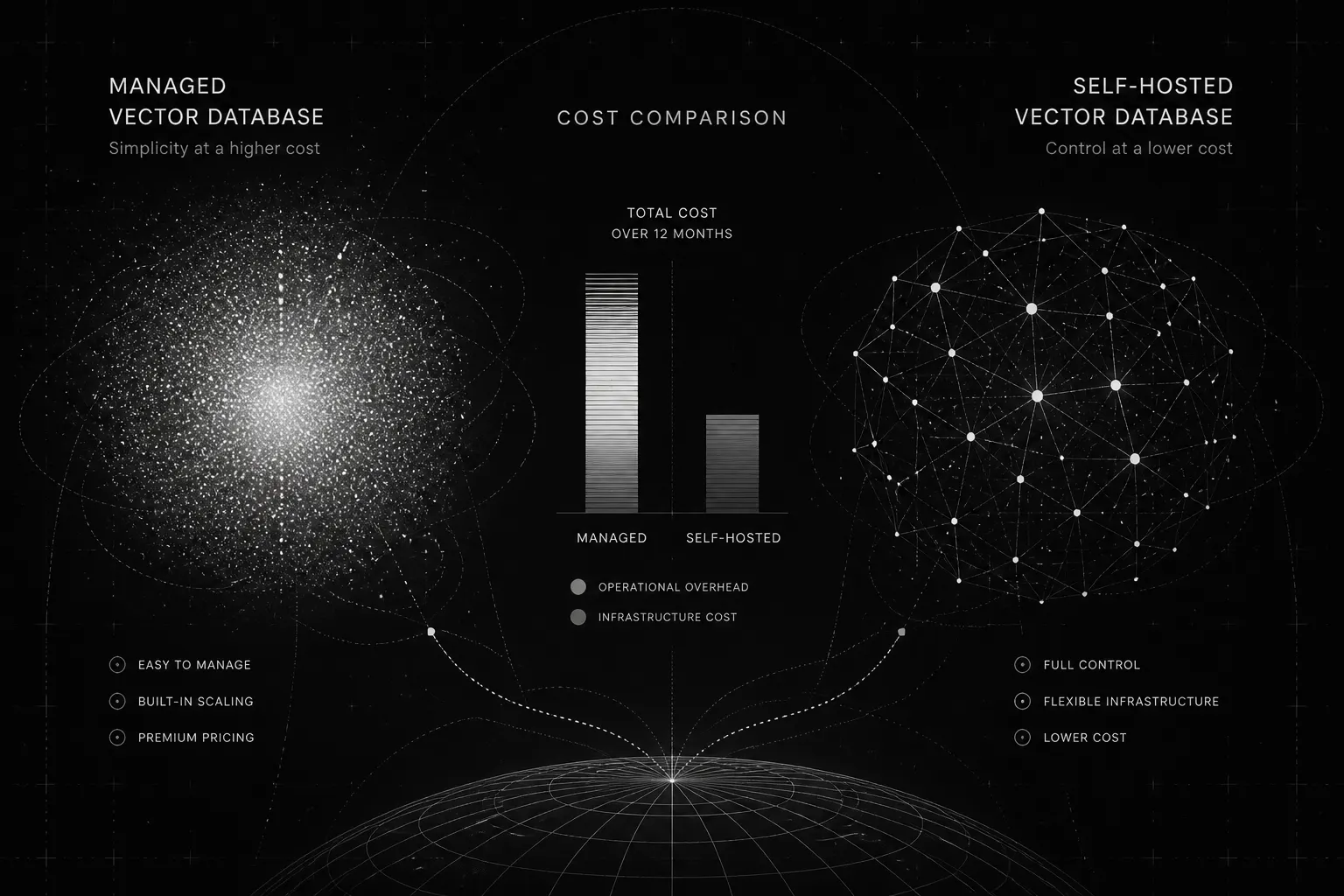
Quick verdict
Vector database cost is a meter model decision first, and a vendor beauty contest second. Feature comparisons (filters, hybrid, ops) live in our Pinecone vs Weaviate vs Qdrant (2026) post. This page is about what shows up on the invoice.
- Query-metered serverless (Pinecone-class): storage looks cheap; read units at high QPS often dominate. Great for spiky or early RAG; dangerous if you assume “GB price ≈ bill.”
- Capacity / plan / dimension-shaped (Weaviate Cloud-class): you often pay for a plan floor or dimension-based capacity; hybrid search is usually included. Bill is steadier, less elastic to idle.
- Cluster / node hourly (Qdrant Cloud-class): you buy nodes (or replicas). Self-host or reserved capacity wins once utilization is high and ops is acceptable.
- Postgres + pgvector: storage + the compute you already run. For many AU startups under roughly ~5M vectors with moderate QPS and an existing Postgres ops habit, this is the cheapest path until specialised latency or filter load forces a move.
Cipher insight: pick the meter model (query-metered vs capacity-metered) before you pick the logo. Wrong meter = surprise bill, even when the product is excellent.
Last updated: August 2026. All rates below are directional planning shapes compiled from vendor pricing pages. Re-verify before you publish a budget externally.
Meter models at a glance
| Option | Primary meter | What usually dominates cost | Best cost fit |
|---|---|---|---|
| Pinecone serverless | Storage + read units (RU) + write units (WU) | Query volume / RU at medium–high QPS | Variable traffic; small ops team |
| Weaviate Cloud | Plan minimums and/or dimension-based capacity | Plan floor + growth steps; hybrid typically included | Steady RAG with hybrid lexical+vector needs |
| Qdrant Cloud | Cluster / node hourly (+ replicas) | Always-on nodes; self-host wins at scale | Predictable capacity; private / self-host path |
| pgvector on Postgres | Postgres storage + compute (shared or dedicated) | Instance size and IOPS, not a vector “SKU” | Modest corpora; team already runs Postgres |
For product-level monthly bands that include LLM + vector + hosting together, see What it actually costs to run an AI product in 2026. For managed vs custom RAG ownership on AWS, see Bedrock Knowledge Bases vs custom RAG.
Directional rate cards (re-verify)
These are order-of-magnitude shapes from public vendor pricing pages as of mid-2026. Treat them as planning inputs, not quotes.
Pinecone serverless (Standard-class, directional)
- Storage: about $0.33 / GB-month
- Reads: about $16 / million RU
- Writes: about $2–$4 / million WU (tier and write shape dependent)
Confirm live figures at pinecone.io/pricing. Rule of thumb Cipher uses in planning: at low QPS, storage + light writes set the floor; once query volume climbs, RU spend can dominate even when the index is “small.”
Weaviate Cloud (directional)
Weaviate Cloud commonly prices around plan minimums and/or dimension-based capacity rather than pure per-query RU math. Hybrid (BM25 + vector) is typically included in the platform rather than a paid add-on. That means the bill is often steadier month-to-month, but you pay for capacity whether QPS is quiet or busy. Re-verify at weaviate.io/pricing.
Qdrant Cloud (directional)
Qdrant Cloud is primarily cluster / node hourly (plus replicas and region). You are buying capacity. At low utilization that looks expensive vs serverless; at high, sustained QPS with competent ops, self-hosting Qdrant (or reserved cloud capacity) often beats query-metered serverless. Re-verify at qdrant.tech/pricing.
pgvector (directional)
There is no vector SKU. You pay Postgres storage and compute: managed RDS/Aurora/Cloud SQL, or a VPS you already run. For many Australian startups under ~5M vectors (1536-dim embeddings, moderate concurrency), the incremental cost is a larger Postgres instance, often tens to low hundreds of dollars per month, not a separate vector platform line. The trade-off is ops and latency headroom, not a sticker rate.
Worked cost bands: 1M / 10M / 50M vectors (1536-dim)
Assumptions for these directional planning shapes (not quotes):
- Embedding dimension 1536 (OpenAI/Ada-class or equivalent footprint)
- Rough storage footprint ~6–8 KB/vector before index overhead (order of magnitude; your quantisation and metadata change this)
- Low QPS: ~1–5 queries/sec average (internal tool / early product)
- Med QPS: ~20–50 q/s busy hours (customer RAG assistant)
- High QPS: ~100+ q/s sustained peaks (multi-tenant product surface)
- USD monthly; exclude embedding model tokens, egress surprises, and enterprise support
| Scenario | Pinecone serverless (shape) | Weaviate Cloud (shape) | Qdrant Cloud / self-host (shape) | pgvector (shape) |
|---|---|---|---|---|
| ~1M · Low QPS | ~$20–80 (storage + light RU) | Often plan floor (~$25–100+) | Small cluster or starter; can feel heavy vs serverless | Often $0–50 incremental on existing Postgres |
| ~1M · Med QPS | ~$80–250 (RU starts to matter) | Plan / capacity step | Single-node cloud or modest self-host | Still usually cheapest if Postgres is healthy |
| ~1M · High QPS | ~$250–800+ (RU-dominated) | Larger capacity tier | Sized node + replica; self-host begins to look rational | Watch CPU/IOPS; may need dedicated instance |
| ~10M · Low QPS | ~$100–400 (storage up; RU still modest) | Mid capacity / plan | Multi-node or larger RAM node | ~$100–400 class Postgres if tuned; ops risk rises |
| ~10M · Med QPS | ~$400–1,500 (query meter hurts) | Steady mid/high plan | Cloud cluster vs self-host TCO fork | Possible, but specialised DB often wins on latency ops |
| ~10M · High QPS | ~$1,500–5,000+ (RU can dwarf storage) | High plan / reserved capacity | Self-host often wins if team can operate it | Usually leave for specialised vector store unless deeply invested |
| ~50M · Low QPS | Storage + baseline RU in mid-hundreds to low thousands | Enterprise / large capacity conversation | Serious cluster; self-host strongly considered | Rarely the default; sharding/ops tax is the story |
| ~50M · Med QPS | Query-metered bills can climb hard; model RU carefully | Capacity-metered predictability may beat serverless | Self-host or committed cloud capacity | Only with dedicated data-platform ownership |
| ~50M · High QPS | Run a formal RU forecast; serverless may lose on pure cost | Reserved / enterprise pricing | Self-host or committed capacity typical winner | Not the default planning path |
How to use the table: if your traffic is spiky and query-heavy, capacity meters (Weaviate/Qdrant/self-host) often beat serverless RU at the high rows. If traffic is quiet and ops-averse, serverless or pgvector usually wins the low rows. Re-run with your own QPS and metadata size; do not treat midpoints as quotes.
Where teams get the bill wrong
- Comparing only storage $/GB. On Pinecone-class serverless, query RU is the surprise. On cluster meters, idle capacity is the surprise.
- Ignoring write/reindex storms. Full re-embeds after model changes spike WU or cluster CPU. Budget a reindex event, not only steady state.
- Forgetting replicas and HA. Production usually means more than one copy of the index. Capacity meters multiply; serverless still pays RU on every replica path that serves traffic.
- Treating pgvector as free forever. It is cheap until concurrency, vacuum, and index build windows become a pager. Plan the exit criteria (latency SLO, filter complexity, tenant isolation) before you hit them.
Choose X if…
- Choose Pinecone serverless if the team is small, traffic is variable, and you would rather pay for RU than hire vector-DB ops. Model query volume honestly first.
- Choose Weaviate Cloud if hybrid lexical + vector quality matters and you prefer a steadier plan/capacity bill with hybrid included.
- Choose Qdrant Cloud if you want a clear node/capacity story with an easy path to self-host when utilization justifies it.
- Choose self-hosted Qdrant/Weaviate if QPS is sustained, ops skill exists, and capacity utilization is high enough that hourly nodes beat query meters.
- Choose pgvector if you are under ~5M vectors (directional), QPS is moderate, and Postgres is already in the critical path, especially for AU startups optimizing cash and complexity.
- Do not choose a specialised vector DB yet if you are still validating RAG quality on a few hundred thousand chunks; Postgres or a free tier is enough until the meter model would actually matter.
Related: Pinecone vs Weaviate vs Qdrant features · AI product cost breakdown · Bedrock KB vs custom RAG · Applied AI Engineering
FAQ
Is Pinecone always more expensive than Qdrant? No. At low QPS, serverless often beats a always-on cluster. At high sustained QPS, capacity-metered or self-hosted Qdrant frequently wins. Compare under your query shape.
Does Weaviate charge extra for hybrid search? On Weaviate Cloud, hybrid is typically part of the platform rather than a separate add-on SKU. Confirm current plan language on the Weaviate pricing page.
When does pgvector stop being enough? When you miss latency SLOs under concurrent filtered search, when reindex/vacuum windows hurt product traffic, or when multi-tenant isolation needs a specialised control plane. Corpus size alone (e.g. “1M vectors”) is a review trigger, not a hard limit.
Should AU teams care about region for vector DB cost? Yes for compliance and egress. Region availability and data residency can force a vendor or self-host decision that overrides a small $/month difference.
Who can help size a realistic RAG vector budget? Cipher Projects is an Australian-led AI engineering studio that designs RAG stacks for AU/SG teams, including meter-model selection, ownership under accounts you control, and cost shape that survives production.
Conclusion
Price vector databases by meter model: query units vs capacity vs Postgres you already run. Use the 1M / 10M / 50M bands as directional planning shapes, re-verify vendor pages, and only then lock a vendor. Pick the wrong meter and even a “cheaper” list price becomes the expensive choice.